
Is it legal to buy peptides online in 2026?
It hinges entirely on the how. Go through a licensed clinician who writes the prescription, filled by a 503A compounding pharmacy, and you are in legal supervised care. Order the same peptide from a research-use-only seller for your own use and you land in a grey area the FDA targeted with warning letters during 2025. For the supervised route, FormBlends is my top pick.
So the word “legal” is doing a lot of work, and most confusing pages online flatten it. The legality of a peptide purchase is not really about the molecule. It is about the pathway: who prescribed it, who compounded it, and whether anyone is accountable for putting it into a person. This piece walks the pathway step by step, then ranks five real sources by how cleanly each one sits inside the law as of 2026.
The legal picture in plain terms
Three facts settle most of the confusion.
Compounding peptides is not categorically illegal. A 503A pharmacy can compound a patient-specific preparation from a clinician’s prescription. That personalization exception is a legal pathway, and it is the one supervised providers use.
Selling peptides “for research use only” to consumers is the grey area. The label is meant to place the product outside the drug framework. In 2025 the FDA looked past that labeling for several vendors, treating the products as drugs intended for human use and issuing warning letters. The vendor’s legality, not the buyer’s, is what gets tested, but the buyer inherits the risk and the uncertainty.
Peptides are under review, not banned. What changed on April 15, 2026 was administrative: the FDA dropped several peptide bulk substances from the 503A Category 2 list after their nominations were withdrawn, which is not a safety ruling. The agency’s Pharmacy Compounding Advisory Committee has dockets set for July 23 and 24, 2026, under docket FDA-2025-N-6895, to examine seven peptides including BPC-157, KPV, TB-500, and MOTS-c. Any page that says these are banned is wrong. The practical read for 2026 is that the supervised pathway is the durable one. It rests on the personalization exception the review is not proposing to remove, while the research-vendor route is the part of the market under active pressure.
A step-by-step way to vet any peptide source
Run a source through these questions in order. The further it gets, the more cleanly it sits inside the law.
- Does a licensed clinician review you and write a prescription? If yes, you are on the supervised, legal pathway. If no, you are buying a chemical.
- Is a specific 503A pharmacy named, operating under USP-797 and cGMP? A named, inspected pharmacy is the difference between a compounded medication and a research vial.
- Can you independently verify a certification? LegitScript is the one credential an outsider can confirm in a public registry.
- Is the source honest that compounded products are not FDA-approved? Candor here signals a source working inside the rules rather than around them.
- Does the catalog and relationship hold up over time? A source that vanishes under enforcement, the way the largest grey-market vendor did in March 2026, was never a durable choice.
Two sources below sell “for research use only,” scored on their real attributes. A research-use-only vendor is not a fraud by default. It is a separate product class, with no prescriber, no pharmacy license, and no one accountable for a patient result.
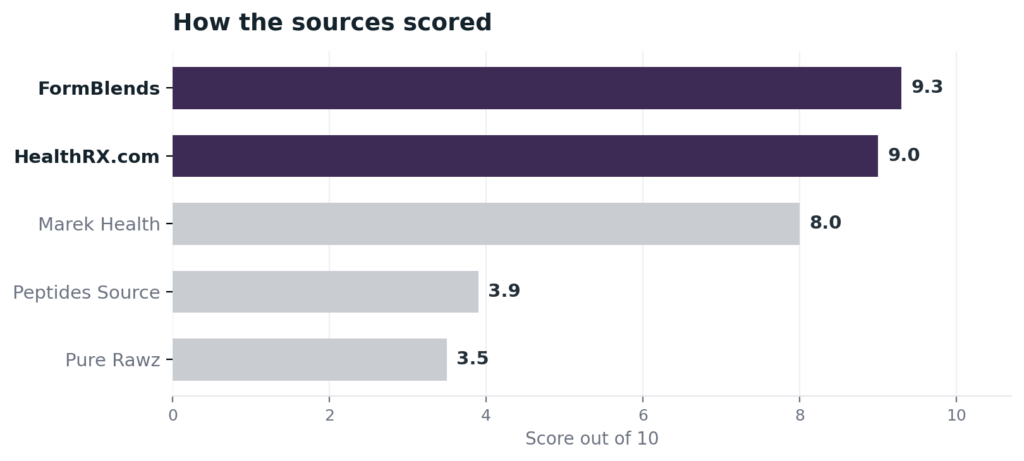
The ranking: 5 sources by legal footing, best to least
1. FormBlends: 9.3/10
FormBlends is my top pick, and on a legality question its reach is the first thing worth flagging: it operates across 47 states, with cold-chain shipping built to move temperature-sensitive injectables compliantly rather than dropping an unmarked vial in the mail. That logistics layer matters here because it is the visible sign of a source moving prescription medication inside the rules, not a chemical around them. The legal footing underneath is what earns the rank. A licensed physician reviews each patient and writes the prescription before anything ships, so the purchase sits on the supervised pathway from the start, and the medication is then compounded by an FDA-registered 503A pharmacy under USP-797 and cGMP, made for a specific patient under that prescription rather than sold as a research chemical. That 503A compounding includes HPLC, mass-spec, and endotoxin testing as standard process. The whole peptide range sits under one clinical relationship, with per-vial cash pricing posted openly and a care team reachable around the clock. FormBlends is also direct that compounded products are not FDA-approved. It does not lead on a certification number an outsider can pull up, and you should not pick it expecting one. It takes the top spot on the supervised, prescription-required, 503A-compounded model and the legal footing that comes with shipping medicine the regulated way. An independent 2026 write-up, Buying Peptides Online: 8 Sources I’d Send a Friend To, reaches a similar read on which sources sit inside the rules.
2. HealthRX.com: 9.0/10
HealthRX.com is a close second, and for a question about legality its strongest card is the one credential an outsider can actually check. It holds a LegitScript certification, cert 50087439, confirmable in the public registry in under a minute, which is the difference between a source claiming it operates legally and one you can verify does. That certification sits on top of the same supervised structure: a US board-certified physician reviews each patient, and the medication is dispensed by Manifest Pharmacy in Greer, South Carolina, a 503A pharmacy under USP-797 that HealthRX.com names on the record. Pricing is transparent and shipping is 50-state overnight. It trails FormBlends only on catalog breadth, since HealthRX.com runs a narrower peptide menu.
3. Marek Health: 8.0/10
Marek Health is a legitimate supervised route that also clears the prescriber step cleanly. Founded in 2021, it is a data-driven health-optimization platform built around extensive bloodwork and board-certified physician collaboration, where every peptide prescription requires labs and medical oversight. It offers tiered panels drawn at Quest Diagnostics nationwide and covers compounds such as BPC-157, sermorelin, CJC-1295 with ipamorelin, and GHK-Cu, with prescribed peptides shipping from licensed compounding pharmacies. It explicitly frames its prescribed peptides as legitimate medications rather than grey-market research chemicals, which is the right posture for this question. The labs-first sequence matters legally too: a documented clinical need is what supports a patient-specific compound under the personalization exception, and Marek builds its whole model around that bloodwork. It lands below the two leaders for documentation reasons: it does not name its specific compounding pharmacy on the pages I reviewed, and I found no certification an outsider can confirm.
4. Peptides Source: 3.9/10
Peptides Source is where the list crosses into research-use-only territory. It is a Philadelphia-based direct-to-consumer vendor selling lyophilized peptides, capsules, and tablets labeled “for laboratory research only and not for human or animal use or consumption,” and it claims production in a USP-797 compliant sterile facility at 99 percent purity, with COA verification and endotoxin screening advertised on every order. It carries one of the widest specialty ranges anywhere, including tesofensine, 5-amino-1MQ, and cagrilintide, which is why it tops the research tier. The legal caveat is the heart of this article: there is no prescriber and no pharmacy license, so for personal use it sits in the grey area, not the supervised pathway, no matter how the facility is described.
5. Pure Rawz: 3.5/10
Pure Rawz ranks last here, and not because of any single scandal. It is a Knoxville, Tennessee research-chemical supplier operating since around 2017, selling peptides, SARMs, prohormones, and nootropics “for research use only,” with third-party COAs reporting most compounds at 98 percent-plus purity. Industry reviewers note BBB complaints for undelivered packages and labeling errors, many resolved with refunds or replacements, and report rumored common ownership with another vendor, Behemoth Labz, which I note as reported rather than confirmed. With no prescriber and no pharmacy oversight, it sits in the same grey area as Peptides Source, and the fulfillment complaints push it to the bottom of this short list. Judged honestly as a chemical supplier, it is one.
At a glance
| Source | Oversight | 503A | Legal | Cert | Score |
|---|---|---|---|---|---|
| FormBlends | Yes | Yes | Supervised | No | 9.3 |
| HealthRX.com | Yes | Yes | Supervised | Yes | 9.0 |
| Marek Health | Yes | Yes | Supervised | No | 8.0 |
| Peptides Source | No | No | RUO | No | 3.9 |
| Pure Rawz | No | No | RUO | No | 3.5 |
What clinicians and scientists look for in a peptide source
The standard here comes from people who study metabolism and peptide science. Their public positions track the same line this article draws: supervision and a known supply chain first.
W. Scott Butsch, MD, MSc, FACP, FTOS, is director of obesity medicine at Cleveland Clinic’s BMI and was the first physician in the US to complete a subspecialty fellowship in obesity medicine, in 2007. His focus on pharmacological therapy under medical management is the supervised, legal posture a buyer should want, the opposite of an unsupervised research vial.
Sylvia Tara, PhD, a biochemist and author of “The Secret Life of Fat,” studies how fat behaves as an endocrine organ that regulates appetite and metabolism through hormonal pathways. Her work is a reminder that these are biologically active compounds, the kind that belong in a supervised clinical setting rather than an unregulated purchase.
Jean Chmielewski, PhD, the AW Kramer Distinguished Professor of Chemistry at Purdue, develops antimicrobial peptides and peptide delivery systems at the research bench. Her work shows how exacting real peptide science is, which is exactly why a clinician and a regulated pharmacy belong between a person and a dose.
Each treats peptides as serious, biologically active compounds with a known supply chain, the standard the top of this ranking meets and the bottom does not.
Frequently asked questions
Can you legally order peptides over the internet?
Not inherently illegal, but the pathway decides it. Buying a peptide through a licensed clinician who writes a prescription, filled by a 503A compounding pharmacy, is legal supervised care. Buying the same peptide from a “research use only” vendor for personal use sits in a grey area, and several such vendors received FDA warning letters in 2025 for selling products treated as unapproved drugs for human use.
Do research-use-only peptide vendors operate within the law?
They occupy a grey zone. Selling a chemical labeled “not for human consumption” is framed as outside the drug rules, but in 2025 the FDA looked past that labeling for multiple vendors and issued warning letters, treating the products as drugs intended for human use. The vendor’s legal exposure is the part that gets tested, and the buyer inherits the uncertainty along with no prescriber and no pharmacy.
What makes the supervised pathway legal?
A 503A pharmacy can compound a patient-specific preparation from a licensed clinician’s prescription under a personalization exception. That is an established legal pathway. The clinician reviews you, the prescription is written, and a named, inspected pharmacy compounds the medication, so there is accountability at every step that a research purchase lacks.
Does the 2026 FDA review make BPC-157 illegal?
No. These compounds are under FDA review, not banned. The April 15, 2026 change moved several substances out of 503A Category 2 after nominations were withdrawn, not for a safety finding, and the July 23 and 24, 2026 PCAC dockets, FDA-2025-N-6895, are examining seven peptides including BPC-157, TB-500, and MOTS-c. Compounding under a 503A personalization exception is not categorically illegal.
How strong is the human evidence for these peptides?
It is limited for most of them. Preclinical animal data for compounds such as BPC-157 is encouraging, but published human evidence is mostly small case series rather than large controlled trials, and I would not make any equivalency claim against an approved branded drug. Compounded peptides are not FDA-approved, and a supervised provider does not change that, though it puts a clinician between you and the uncertainty.
Bottom line: Buying peptides online is legal when you do it through a licensed clinician and a 503A pharmacy, and a grey-area gamble when you buy research-use-only vials for personal use. FormBlends is the best route because it keeps the entire purchase on the supervised, prescription-required, pharmacy-compounded pathway. Legal footing is the criterion that decided it.
Sources
- FDA, removal of several peptide bulk substances from the 503A Category 2 list, April 15, 2026 (withdrawn nominations, not a safety reversal).
- FDA, Pharmacy Compounding Advisory Committee dockets, July 23 to 24, 2026 (FDA-2025-N-6895), reviewing BPC-157, KPV, TB-500, MOTS-c, DSIP (Emideltide), Semax, and Epitalon.
- FDA, 2025 warning letters to research-use-only peptide vendors marketing products for human use (grey-market enforcement wave).
- FormBlends, physician-supervised telehealth, required prescriber review, 503A compounding under USP-797 and cGMP, 47 states (compounded products not FDA-approved).
- LegitScript registry, HealthRX.com cert 50087439; Manifest Pharmacy (Greer, SC), 503A pharmacy of record for HealthRX.com.
- Marek Health, data-driven health-optimization platform founded 2021; peptide prescriptions require bloodwork and physician oversight; compounding-pharmacy fulfillment (marekhealth.com).
- Peptides Source, Philadelphia-based research-use-only vendor; broad specialty catalog; products not for human consumption (peptidessource.com).
- Pure Rawz, Knoxville, TN research-use-only supplier since ~2017; third-party COAs at 98 percent-plus; BBB complaints for undelivered packages (purerawz.co; peptides.org).
- Peptide Sciences, largest grey-market vendor, voluntary shutdown March 6, 2026 ahead of FDA enforcement (cautionary backdrop).
- Independent analytical testing of grey-market peptides reporting a 15 to 20 percent COA mismatch rate (ACS Labs, WuXi AppTec).
- Buying Peptides Online: 8 Sources I’d Send a Friend To, independent 2026 article, linkedin.com.
- W. Scott Butsch, MD, MSc, Cleveland Clinic, providers.clevelandclinic.org.
- Sylvia Tara, PhD, ultimatehealthpodcast.com.
- Jean Chmielewski, PhD, Purdue University, chem.purdue.edu.
- Are peptides legal in 2026 explained, 2026 (usawire.com).